Losing the World’s Largest Population of Warea amplexifolia or not?

by Vicky McLean, The Villages Chapter, FNPS
Can plants break your heart? Absolutely!
I became interested in the federally endangered plant Clasping Warea (Warea amplexifolia). I started googling. Every reference I came across said that Lake Griffin State Park had the largest population in Florida. Since Warea is endemic to Central Florida, that means that Lakr Griffin has the largest population of Warea in the world! Lake Griffin State Park is only a twenty-minute drive from The Villages, our FNPS chapter’s home!
 I knew Lake Louisa State Park had about ten acres of Warea, so I was excited to see the Lake Griffin population for myself. It didn’t take long to see that the current Warea population at Lake Griffin is measured in square feet - definitely not the largest population.
 Lake Griffin State Park’s Warea amplexifolia population has fluctuated wildly since the park was founded in 1946. Before the 1990s much of the parcel where the Warea is found was allowed to transition from sandhill to xeric hammock due to fire exclusion. When an early-career Shirley Denton was hired to inspect an area of wiregrass (Aristida sp.) restoration there was no Clasping Warea to be seen, and some hand-pulling of non-native grass was evident. A few years later, she revisited the wiregrass restoration site after hearing that the Warea population rebounded. Evidence of a recent fire (less than six months prior) abounded. The Warea was in full bloom, plants were flagged, and the wiregrass was doing well.
 Clasping Warea is an annual herbaceous early successional plant that propagates solely by seed. It disappears quickly if it is too crowded by weedy herbaceous plants and/or by shade. Since then, the area hasn’t been burned frequently enough and Natal grass (Melinis repens) was flourishing just across the park’s border, along the area where Warea grew. The grass not only invaded Warea’s habitat but was choking it.
Here’s the history. Natal grass was introduced to Florida in 1875 as a cattle forage plant, but it lacked nutritional value and so wasn’t effective for that purpose. Promoted through the Agricultural Experiment Station near Miami, by 1914 Florida had planted around 30,000 acres of Natal grass. It was also planted between rows of citrus trees to smother weeds.
The problem is how to control the invasive grass and conserve the Warea population. A team of people from FNPS, FNPS The Villages, Lake Griffin State Park, and the Florida Park Service got together to tackle the problem. The Lake Griffin State Park staff and District Biologist came up with an annual calendar for implementing these tasks for controlling the Natal grass:
- hand-pulling seed heads
- applying pre-emergent herbicide
- mowing
- mechanical seed extraction
- seed disposal
- applying post-emergent herbicide
The Villages FNPS chapter wrote the grant proposal. FNPS funded it with the 2023 Conservation Grant of $5,000.
Below: Zone 1 pre-treatment
Funding was received in July 2023. Lake Griffin State Park provided tens of thousands of dollars in in-kind support and resources already owned by the park service.
Work began in two selected park zones. Herbicides were purchased and oddly common equipment—shop vacs and a generator for mechanical seed extraction. The generator was mounted on a small vehicle to power two shop vacs strapped behind. The shop vacuums were used to suck up seed heads after they were hand-clipped from the Natal grass. Contractors and volunteers got started.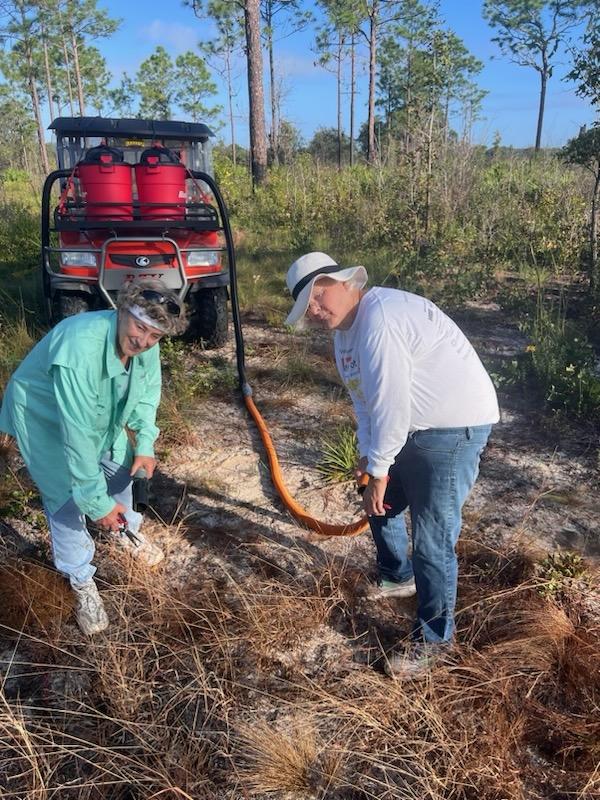
 Careful seed disposal was critical. Natal grass seed clung to everything, and all the vehicles, equipment, materials, and clothing had to be decontaminated after each use, to avoid transmitting the seeds. (Note: Burning increases the success of proliferation of Natal grass, so burning the seeds was prohibited) Seeds were destroyed using the “bag and bake” method. They were bagged in heavy-duty plastic and sent to the landfill.

Zone 1 Pretreatment

Zone 1 post-treatment
In the fall of 2023, there was no visible germination of the site’s Warea population. But it is important to note that Warea seed can survive in situ for seasons, until conditions are right for growth. (Note: Warea amplexifolia typically blooms in September-October.) As of the time of this writing (six months into the grant project), the site has a 90% reduction in Natal grass. The team is hopeful and is waiting through dry-season dormancy. Work and data collection are to begin again soon.
If the project is deemed to be successful, Lake Griffin State Park will adopt the control procedures into their normal Standard Operating Procedures, so control of the invasive grass will continue. Moreover, if the procedures work, they will be presented and shared across the state with the Florida State Park Service for potential adoption or adaption at other parks.
Just a little “seed money” from FNPS can be a real kick-starter to make a difference, not only for the environment but also in peoples’ careers. The district biologist who works with Lake Griffin State Park stated, “I have a fascination with and have worked 33 years with Warea. I want to see Warea flourishing here. I want an all-in maintenance program for the future park and biological staff.” When asked why the park staff members wanted to do this grant, they said, “I want to leave a signature…a footprint for the future. I want to share with the park service and other agencies what we learn here.” This species loss heartbreak is turning hopeful.
The Villages Chapter was awarded a FNPS Conservation Grant in 2023
This article appeared in the Sabal Minor.